
Engaging Activities for Teaching Opposites to Preschoolers
The world through a preschooler’s eyes is a vibrant tapestry of new discoveries, and among the most fundamental of these are the concepts of opposites. Understanding opposites is not merely about memorising word pairs; it’s a critical cognitive leap that lays the groundwork for logical thinking, language development, and a deeper comprehension of the world around them. For young children, the ability to discern differences between objects, qualities, and actions is essential for building a robust vocabulary and developing early critical thinking skills. This article explores various engaging and enriching activities designed to introduce and reinforce the concept of opposites for preschoolers, transforming a potentially abstract lesson into a delightful and memorable learning experience.
Contents
The Foundation: Introduction to Opposites
Introducing opposites to preschoolers doesn’t require textbooks or formal lessons. Instead, it thrives on playful exploration and consistent exposure within their everyday lives. Opposites are everywhere, from the temperature of their bathwater to the size of their toys. The key is to highlight these contrasting elements in a way that is natural and easy for them to grasp.
Why Opposites Matter: Importance of Teaching Opposites to Preschoolers
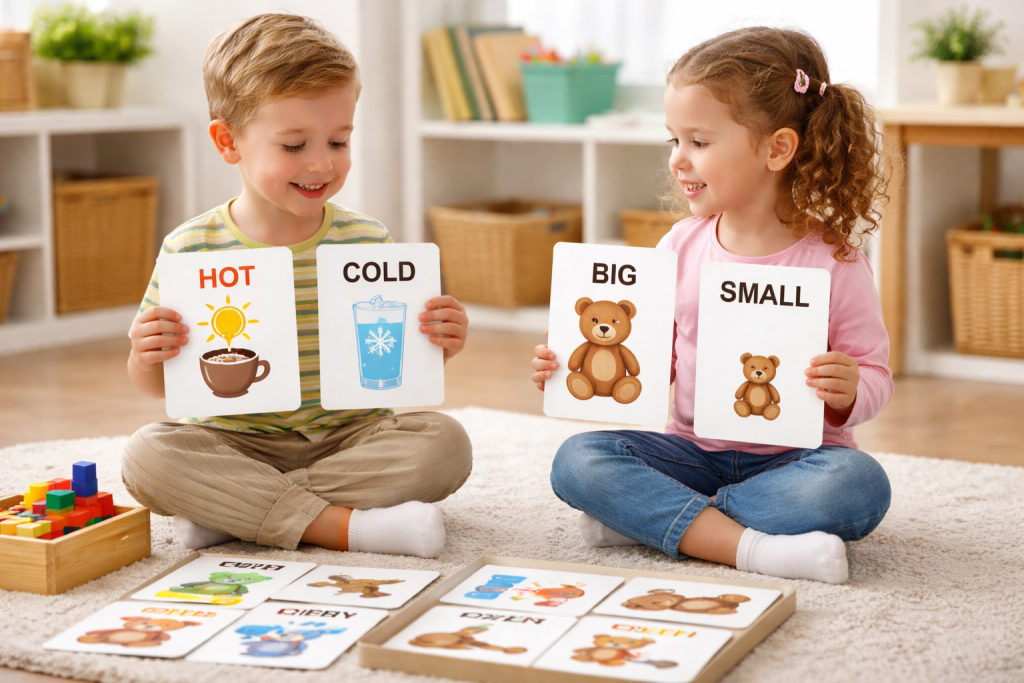
Teaching opposites is far more than an academic exercise; it’s a cornerstone of early childhood development. When preschoolers understand concepts like “big” and “small” or “hot” and “cold”, they begin to categorise their environment, identify relationships between objects, and build a more sophisticated understanding of abstract concepts. This foundational knowledge directly impacts their language acquisition, as it provides a framework for describing and differentiating objects and experiences. Furthermore, a strong grasp of opposites enhances their problem-solving abilities. If a child understands that a “long” string is needed for one task, they can then identify a “short” string as unsuitable, demonstrating early logical reasoning. It also promotes an appreciation for order and structure, helping them make sense of the world’s complexities. Ultimately, learning opposites empowers preschoolers to articulate their observations, ask more precise questions, and engage more deeply with their surroundings.
Hands-On Exploration: Fun and Interactive Opposites Activities
The most effective way to teach preschoolers is through active participation. Engaging their senses and encouraging hands-on experiences makes learning indelible.
Visual Learning: Using Visual Aids to Teach Opposites
Visual aids are powerful tools for young learners. Flashcards depicting pairs like “day” (with a sun) and “night” (with a moon), or “happy” (with a smiling face) and “sad” (with a frowning face), provide clear and immediate representations of opposite concepts. Picture books specifically designed to highlight opposites are also invaluable resources. These books often use vibrant illustrations to show contrasting concepts in action, making the learning process both enjoyable and informative. Magnetic boards with corresponding opposite images or even simple drawing activities where children are asked to draw a “big” apple and a “small” apple can solidify their understanding. The consistent visual pairing helps them to associate the words with their corresponding meanings effortlessly.
Narrative Fun: Incorporating Opposites into Storytelling
Storytelling is a magical gateway to learning for preschoolers. Creating or reading stories that inherently feature opposite characters, settings, or events can be incredibly effective. Imagine a tale about a “fast” rabbit trying to outrun a “slow” turtle, or a “loud” lion and a “quiet” mouse. As you read, emphasise the opposite words with your voice, perhaps using different tones or inflections. Encourage children to participate by asking them to identify the opposites in the story or to predict what might happen next based on contrasting events. Puppet shows can further enhance the learning experience with puppets representing opposite characters or demonstrating opposite actions. This narrative approach embeds the concepts within a memorable and emotionally resonant context, making them easier to recall and apply.
Playful Learning: Opposites Games for Preschoolers
Games transform learning into sheer delight. “Simon Says” can be adapted to focus on opposites; for example, “Simon Says, stand up tall” followed by “Simon Says, crouch down low.” A “find the opposite” game where children are given an item (like a “hard” block) and asked to find its opposite (a “soft” stuffed animal) encourages active exploration. Sorting activities, such as placing “light” objects in one basket and “heavy” objects in another, also provide a hands-on experience with contrasting qualities. Memory games with opposite pairs hidden under cards can sharpen their cognitive skills while reinforcing the vocabulary. These playful interactions make the learning process feel effortless and organic.
Active Engagement: Integrating Movement and the Outdoors
Preschoolers thrive on movement and outdoor exploration. These environments offer rich opportunities to teach opposites in a dynamic and engaging way.
Rhythmic Learning: Music and Movement Activities for Opposites
Young children’s development intrinsically links music and movement, providing a fantastic avenue for teaching opposites. Songs that feature opposite lyrics, such as “Up and down, up and down, that’s the way we go around!” or “Fast and slow, fast and slow, let’s all make our bodies go!” can be combined with corresponding actions. Ask children to jump “high” and then stoop “low”, or to move their arms “fast” and then “slowly”. Dance parties where you call out opposite movements—”big steps!” followed by “tiny steps!”—make learning interactive and fun. The rhythmic repetition inherent in music helps embed the concepts in their memory, and the physical actions connect the abstract words to concrete experiences.
Nature’s Classroom: Outdoor Opposites Exploration
The vast outdoors offer a wealth of educational opportunities. Take children on a “nature walk” and actively point out opposites found in their natural environment. “Look at the big tree and the small bush next to it!” or “Feel the rough bark and the smooth stone!” Engage their senses by asking them to identify “hard” rocks and “soft” grass or to listen for “loud” bird calls and “quiet” rustling leaves. A sandbox can become a laboratory for “wet” and “dry” sand. A trip to the park can highlight “fast” swings and “slow” slides. These real-world examples make the concepts tangible and relevant to their daily experiences, fostering an appreciation for the diversity of their surroundings while reinforcing their understanding of opposites.
Creative Expression: Arts and Crafts Opposites Projects
Art offers a unique and personal way for preschoolers to express their understanding of opposites, fostering creativity alongside learning.
Crafty Contrasts: Arts and Crafts Opposite Projects
Arts and crafts provide a wonderful outlet for preschoolers to explore opposites through hands-on creation. Provide them with “light”-coloured construction paper and “dark”-coloured paper, and encourage them to create contrasting collages. Offer “big” sponges and “small” brushes for painting, allowing them to experiment with different sizes and textures. Clay or playdough activities can focus on creating “long” snakes and “short” worms, or “thin” pancakes and “thick” cookies. Making “happy” masks and “sad” masks, or drawing “dirty” clothes and “clean” clothes, allows them to visually represent emotional and physical opposites. These creative projects not only reinforce the vocabulary but also develop fine motor skills and encourage individual expression. The tangible outcome of their efforts serves as a rewarding reminder of the concepts learned.
Sustained Learning: Tips for Reinforcing Opposites Learning at Home
Learning doesn’t stop at school or during dedicated activity time; daily reinforcement at home is crucial for long-term retention.
Everyday Reinforcement: Tips for Reinforcing Opposites Learning at Home
Parents and carers play a vital role in reinforcing the learning of opposites. Incorporate opposite language into everyday routines. While getting dressed, talk about “long” pants and “short” sleeves. Talk about “hot” food and “cold” drinks during mealtime. When cleaning up toys, distinguish between “big” toys and “small” toys. Read picture books together that highlight opposites, asking questions like, “Can you point to the big dog and the small cat?” Make it a game during car rides, identifying opposites seen through the window. Consistent and natural exposure within their home environment will solidify their understanding and demonstrate the practical application of these concepts in their daily lives. The more integrated opposites become in their vocabulary and experiences, the more deeply they will grasp this fundamental aspect of language and cognition. By making learning playful and relevant, we empower preschoolers to confidently navigate and describe the rich tapestry of the world around them.
Emma Carter is an early childhood education enthusiast and content creator at Edyzoa. She is passionate about helping children learn through fun, engaging, and safe educational resources that support creativity, curiosity, and skill development.