In an era saturated with digital distractions, the enduring appeal of tactile, engaging toys remains a powerful force in shaping young minds. Educational toys, far from being mere playthings, are meticulously designed tools that gently guide children through crucial developmental milestones. They are the silent partners in a child’s learning journey, transforming exploration into understanding and play into a potent catalyst for intellectual growth. Unlike passive entertainment, these carefully curated items invite active participation, encouraging children to experiment, discover, and build foundational skills that will serve them throughout their lives. Introducing children to the realm of learning through play unlocks a vast array of opportunities, rewarding curiosity with knowledge and fostering imagination.
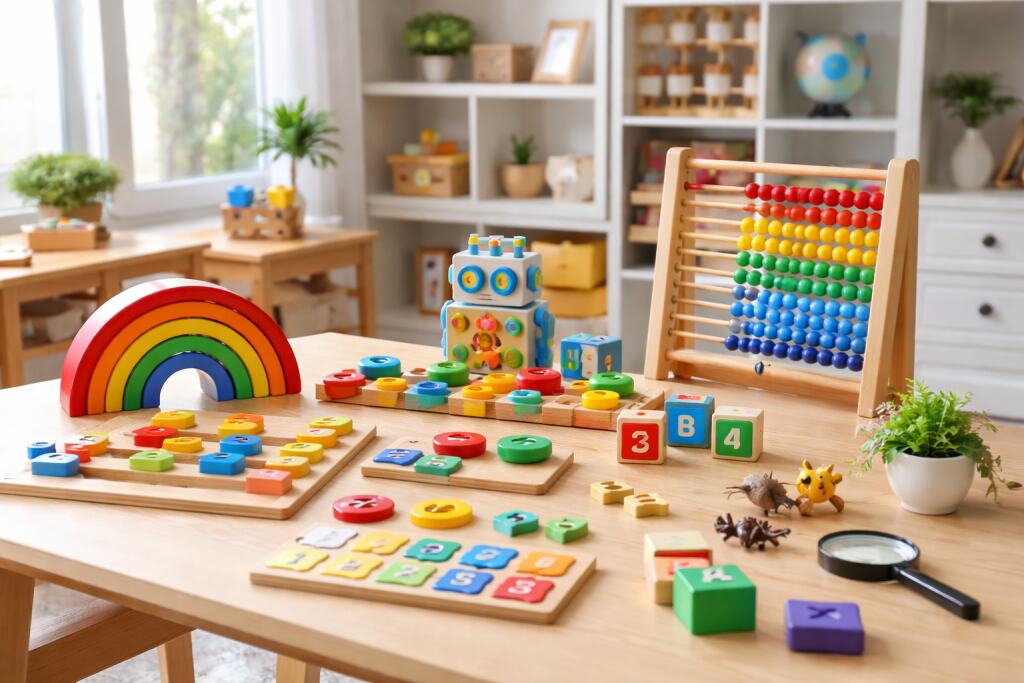
The Benefits of Educational Toys for Children’s Development
The impact of educational toys on a child’s holistic development is profound and far-reaching. They are more than just tools for academic learning; they are integral to nurturing well-rounded individuals. From the earliest stages of infancy, even simple stacking rings or textured balls can stimulate sensory exploration and hand-eye coordination. As children grow, the complexity and variety of educational toys expand, mirroring their evolving cognitive abilities. These toys encourage a sense of accomplishment and build crucial self-confidence as children overcome challenges and master new skills. The process of engaging with these thoughtfully designed objects is inherently rewarding, encouraging persistence and a positive attitude toward learning.
Cognitive Development: Building the Foundation for Learning
The most immediate and often recognised benefit of educational toys lies in their ability to stimulate and enhance cognitive development. This encompasses a wide spectrum of mental processes, including memory, attention, logical reasoning, and spatial awareness. Toys that require children to sort, match, or build introduce them to fundamental concepts of classification and pattern recognition. Puzzles, for instance, are a classic example, demanding focus, spatial reasoning, and the ability to mentally manipulate pieces. Building blocks, whether wooden or magnetic, empower children to understand concepts of balance, gravity, and structural integrity, laying the groundwork for later mathematical and scientific understanding. The act of problem-solving inherent in many educational toys encourages the development of executive functions, such as planning, organisation, and impulse control.
Nurturing Logic and Reasoning with Building Toys
The simple act of stacking blocks might seem elementary, but it is a powerful engine for cognitive growth. As children learn to balance one block upon another, they are implicitly grasping principles of physics and stability. More complex building systems, such as magnetic tiles or interlocking bricks, introduce them to geometric shapes, angles, and the concept of interlocking systems. This tactile exploration directly translates into an understanding of spatial relationships, a critical component of mathematical and scientific aptitude. The process of trial and error, inherent in building, hones their problem-solving skills. If a structure collapses, the child is motivated to analyse why and adjust their approach, fostering critical thinking and resilience.
Enhancing Memory and Concentration with Matching and Sorting Games
Games that require matching or sorting objects by colour, shape, or size are invaluable for developing memory and concentration. These activities demand visual acuity and the ability to recall specific attributes of objects. A child playing a memory matching game, where cards are flipped and must be paired, is actively engaging their short-term memory and their ability to focus amidst distractions. Similarly, sorting activities, like placing coloured rings onto pegs or grouping animal figures, help children develop categorisation skills. This ability to group and organise information is fundamental for understanding larger concepts and for efficient information processing throughout their academic careers.
Enhancing Fine Motor Skills with Educational Toys
Beyond purely cognitive gains, educational toys play a crucial role in refining the intricate movements of a child’s hands and fingers. Fine motor skills are essential for a multitude of tasks, from holding a pencil to buttoning a shirt, and their development begins early. Toys that require dexterity and precision are paramount in this area. Threading beads onto a string, for example, demands coordinated finger movements and visual graphs. Manipulating small puzzle pieces, turning tiny gears, or using Play-Doh to create shapes all contribute to developing the small muscle groups in the hands and improving finger isolation. These skills are not only important for everyday tasks but are also foundational for early literacy development, particularly for handwriting.
Developing Hand-Eye Coordination with Manipulative Toys
Many educational toys are specifically designed to bridge the gap between what a child sees and what their hands can do. Manipulative toys, which involve picking up, placing, and moving small objects, are excellent for honing hand-eye coordination. Think of lacing boards, where children must guide a string through pre-punched holes, or pegboards, where they must place pegs into specific openings. These activities require precise visual tracking and the ability to translate that visual information into controlled hand movements. The more a child engages with these types of toys, the more fluid and accurate their actions become, a skill that will benefit them in everything from sports to academic tasks.
Strengthening Finger Dexterity with Puzzle and Construction Sets
The intricate nature of many puzzles and construction sets naturally lends itself to strengthening finger dexterity. Picking up small puzzle pieces, fitting them into place, or connecting tiny interlocking bricks all require a high degree of finger control and independent finger movement. This builds the strength and agility in the hands and fingers, preparing them for more complex tasks like writing or playing musical instruments. The repetitive nature of these activities, combined with the satisfaction of completing a task, makes them engaging and highly effective for fine motor development.
The Role of Educational Toys in Language Development
Play deeply intertwines with the journey of language acquisition. Educational toys provide a rich and interactive environment for children to explore and develop their linguistic abilities, from understanding their first words to constructing complex sentences. Toys that encourage storytelling, role-playing, or simply involve naming and describing objects can significantly boost a child’s vocabulary and their ability to express themselves. The more a child interacts with their environment and the objects within it, the more opportunities they have to hear and use language, fostering a deeper comprehension and a richer command of words.
Fostering Vocabulary and Communication through Role-Playing and Storytelling Toys
Role-playing toys, such as doctor kits, play kitchens, or dress-up clothes, are powerful tools for language development. They allow children to step into different characters and scenarios, encouraging them to use new vocabulary and to practise different communication styles. Creating stories with puppets or sequencing cards further enhances their narrative skills. These activities encourage children to articulate their thoughts, describe actions, and engage in imaginative dialogue, all of which contribute to a more robust understanding and use of language.
Building Comprehension and Expressive Language with Interactive Books and Games
Interactive books, with their engaging textures, pop-up elements, and clear, concise text, are excellent for building comprehension. Similarly, many board games or card games designed for young children involve following instructions, identifying objects, or answering questions, all of which enhance their ability to understand and respond verbally. The turn-taking inherent in many of these games also encourages children to listen attentively and to formulate their contributions to the conversation, developing both receptive and expressive language skills.
Boosting Creativity and Imagination with Educational Toys
Perhaps one of the most cherished aspects of childhood is the boundless realm of imagination, and educational toys are powerful allies in nurturing this vital quality. While some toys are designed for specific learning outcomes, others excel at providing open-ended opportunities for children to invent, explore, and express their unique inner worlds. These toys act as springboards for imaginative thought, allowing children to create their own games, stories, and scenarios, which encourages autonomy and self-expression.
The Open-Ended Nature of Building and Art Supplies
The beauty of open-ended educational toys lies in their versatility. Building blocks, for instance, can become anything a child dreams of – a castle, a spaceship, or a towering skyscraper. Art supplies, from crayons and paint to clay and craft materials, offer limitless possibilities for visual expression. These toys empower children to be the architects of their own creations, fostering innovation and encouraging them to think beyond conventional boundaries. The process of bringing an idea to life is immensely rewarding and builds confidence in their creative abilities.
Encouraging Imaginative Play with Pretend Play Sets
Pretend play sets, whether they involve a doctor’s office, a grocery store, or a magical land, are fertile ground for imagination. Children can assign roles, create dialogue, and develop complex narratives, all while improvising and inventing scenarios. This type of play is not just about enjoyment; it’s a crucial way for children to process their understanding of the world around them, explore different social dynamics, and develop their capacity for empathy. The more they are given opportunities for imaginative play, the richer and more imaginative their inner world becomes.
Educational Toys for Problem-Solving and Critical Thinking
The modern world demands individuals who can analyse situations, devise solutions, and think critically. Educational toys are instrumental in cultivating these essential skills from an early age. Toys that present challenges, require strategic thinking, or involve deciphering patterns equip children with the tools they need to navigate complex problems and make informed decisions. The process of overcoming a challenge in a playful context builds resilience and fosters a positive attitude toward problem-solving.
Nurturing Analytical Skills with Logic Puzzles and Strategy Games
Logic puzzles, such as tangrams or pattern blocks, challenge children to analyse visual information, identify relationships between shapes, and apply rules to achieve a desired outcome. Strategy games, even simpler versions for younger children, require foresight, planning, and the ability to anticipate consequences. These games teach children the importance of considering different options and making reasoned choices, developing their analytical skills and their capacity for strategic thinking.
Developing Decision-Making Muscles with STEM-Focused Toys
Science, Technology, Engineering, and Mathematics (STEM)-focused toys are particularly adept at fostering problem-solving and critical thinking. Building circuits to make a light bulb glow, programming a simple robot to navigate a maze, or experimenting with levers and pulleys all involve a process of hypothesis, experimentation, and analysis. Children learn to identify variables, understand cause and effect, and iteratively refine their approaches. These toys not only make complex concepts accessible but also instil a confidence in their ability to tackle scientific and technological challenges.
Choosing the Right Educational Toys for Your Child’s Age and Developmental Stage
maximisingSelecting educational toys that align with a child’s specific age and developmental stage is paramount to maximizing their benefit. A toy that is too simple may lead to boredom, while one that is too complex can result in frustration. Understanding the typical developmental milestones for different age groups will guide you in making informed choices that are both engaging and appropriately challenging.
Understanding Developmental Milestones: A Guiding Principle
For infants, focus on toys that stimulate sensory exploration – soft balls, rattles, textured books. As they enter toddlerhood, introduce toys that encourage gross motor skills like ride-on toys and stacking cups, alongside early fine motor development with chunky puzzles and shape sorters. Preschoolers benefit from toys that foster imagination and early literacy, such as pretend play sets, building blocks, and simple board games. School-aged children can engage with more complex STEM toys, strategy games, and elaborate building sets that challenge their problem-solving abilities.
Prioritizing Safety and Durability in Toy Selection
Safety and durability are non-negotiable factors when choosing any toy, especially educational ones. Ensure that toys are made from non-toxic materials and are free from small parts that could pose a choking hazard for younger children. Durable toys will withstand enthusiastic play and last longer, providing continued educational value. Investing in quality, well-made toys is ultimately more cost-effective and better for the environment.
Incorporating Educational Toys into Your Child’s Playtime
When you seamlessly integrate educational toys into a child’s natural inclination to play, they reveal their true magic. It’s not about forced learning sessions but about creating an environment where exploration and discovery are an inherent part of their daily rhythm. Think of educational toys as invitations to learn, rather than mandatory assignments.
Creating a Playful Learning Environment at Home
Designate a space in your home where toys are accessible and inviting. Rotate toys periodically to keep them novel and engaging. Instead of simply presenting a toy, engage with your child during playtime. Ask open-ended questions, offer gentle prompts, and celebrate their efforts and discoveries. By sharing in their play, you model curiosity and a love for learning.
Balancing Screen Time with Hands-On Play Experiences
In today’s digital age, it’s crucial to strike a healthy balance between screen time and hands-on play. Educational toys offer a vital counterpoint to passive digital consumption, providing essential tactile experiences and fostering kinaesthetic learning. Encourage your child to engage with toys that require active participation and manipulation, promoting physical and cognitive development that screens cannot replicate.
Tips for Maximizing the Educational Benefits of Toys for Your Child
Simply purchasing educational toys is only the first step; actively optimising their use ensures that your child reaps the maximum developmental benefits. It’s about thoughtful engagement and intentionality in how these tools are presented and utilised.
The Power of Parental Involvement and Interaction
Your involvement in your child’s play is invaluable. Don’t just hand over a toy and walk away. Sit with them, ask questions, and engage in pretend play. For instance, with building blocks, you can ask, “What do you think will happen if you put this block here?” or with a science kit, “What do you predict will happen when we mix these two ingredients?” This interaction transforms playtime into a rich learning experience, fostering deeper understanding and critical thinking.
Encouraging Independent Exploration and Discovery
While parental guidance is important, it’s equally crucial to allow your child the space for independent exploration. Let them experiment, make mistakes, and discover solutions on their own. If a puzzle proves challenging, resist the urge to jump in immediately. Instead, offer encouragement and ask guiding questions like, “What parts of the picture are similar?” or “What shape might fit there?” This fosters resilience, problem-solving skills, and a sense of self-efficacy.
By thoughtfully selecting and intentionally integrating educational toys into your child’s life, you are investing in their future, nurturing their potential, and laying the groundwork for a lifelong love of learning and discovery. These remarkable tools are not just about building a better child but about building a better future, one playful step at a time.