Embarking on a mathematical journey doesn’t always require textbooks and daunting equations. Sometimes, the most effective and enjoyable way to engage with numbers and logic is through the captivating world of math puzzles. This article will describe how these intriguing challenges can transform your perception and proficiency in mathematics, starting with the very basics and gradually exploring more advanced concepts.
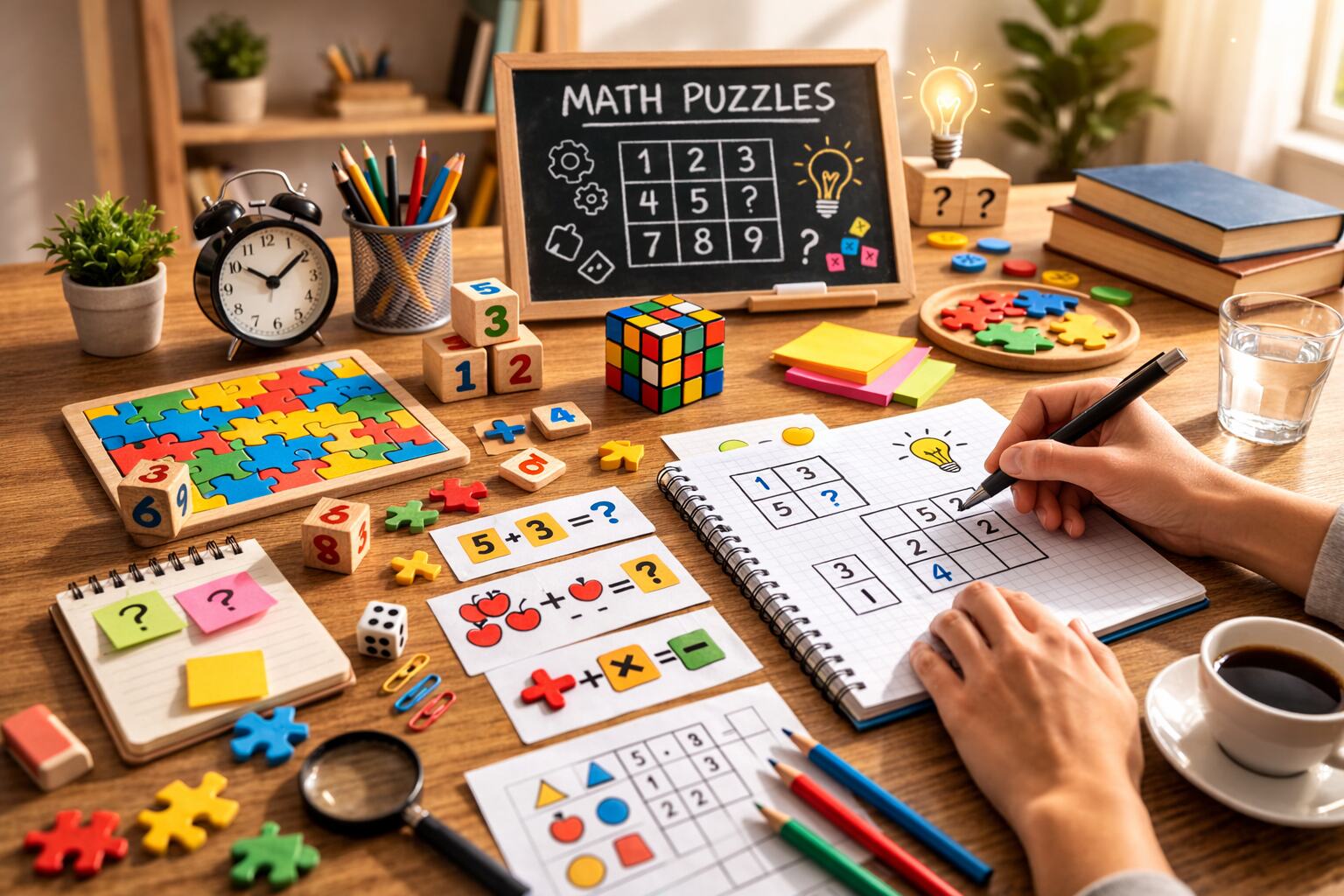
Math puzzles are essentially brain teasers that require the application of mathematical principles, logic, and reasoning to find a solution. For beginners, these puzzles serve as a gentle and inviting entry point into the realm of mathematical thinking. They are designed to be accessible, often avoiding complex formulas and instead focusing on fundamental operations, patterns, and deductive reasoning. Think of them as games where numbers are the pieces and logic is the rulebook. The beauty of beginner puzzles lies in their ability to demystify mathematics, presenting it not as a subject to be feared but as a fascinating field ripe for exploration. They build confidence by offering achievable victories, encouraging a positive association with problem-solving from the outset.
What Constitutes a Math Puzzle for Beginners?
For those new to the world of mathematical challenges, a “beginner” puzzle is characterised by its straightforward premise and reliance on foundational arithmetic. These might include simple addition, subtraction, multiplication, and division, often presented in a story or visual format to make them more relatable. Puzzles involving number sequences, missing numbers in patterns, or basic logic grids fall under this umbrella. The emphasis is on understanding the core concept and applying a few logical steps to arrive at the answer. The goal is not to stump but to guide the solver towards developing an intuitive grasp of mathematical relationships.
Why Start with Puzzles?
Starting with puzzles offers a distinct advantage for beginners. Unlike traditional exercises that can sometimes feel rote, puzzles inject an element of fun and intrigue. This playful approach can significantly reduce maths anxiety and foster a genuine interest in numerical exploration. By engaging with puzzles, beginners learn to think critically and creatively about problems, developing essential skills without the pressure of formal assessment. It’s about building a strong foundation of curiosity and a belief in one’s ability to tackle mathematical challenges.
The advantages of engaging with math puzzles extend far beyond simply arriving at a correct answer. They are powerful tools for cognitive development, sharpening the mind in numerous ways that are transferable to all aspects of learning and life. The process of unravelling a puzzle cultivates a unique set of mental muscles, making individuals more adept at navigating and solving problems, both within and outside the mathematical domain.
Enhancing Problem-Solving Skills
Every math puzzle fundamentally represents a mini-problem that requires resolution. The act of dissecting the puzzle, identifying the knowns and unknowns, and strategising a path to the solution is the very essence of problem-solving. Puzzles train the brain to approach challenges systematically, breaking down complex issues into more manageable parts. This iterative process of analysis, hypothesis, and testing is invaluable.
Sharpening Logical and Critical Thinking
Math puzzles are inherently exercises in logic. They demand that solvers analyse information, identify patterns, make deductions, and evaluate different approaches. Critical thinking is honed as individuals learn to question assumptions, scrutinise evidence, and distinguish between valid and invalid reasoning. This disciplined mental approach is crucial for making sound decisions and forming informed opinions.
Improving Concentration and Focus
Many maths puzzles require sustained attention to detail. Concentration is necessary to complete a puzzle without becoming distracted or making careless errors. Regular engagement with such challenges can significantly improve a person’s ability to focus for extended periods, a skill that is hugely beneficial in academic pursuits, work, and even daily life.
Boosting Memory and Reasoning Abilities
As you work through puzzles, you are constantly recalling and applying rules, facts, and strategies. This active recall strengthens memory. Furthermore, the process of piecing together clues and constructing a logical argument to reach a solution enhances reasoning abilities, making it easier to follow complex lines of thought.
Fostering Creativity and Innovation
While maths is often perceived as rigid, puzzles can unlock creative thinking. Finding a unique or elegant solution often requires thinking beyond conventional boundaries and exploring unconventional approaches. This ability to generate novel ideas and solutions is a hallmark of innovation.
Math puzzles are not just for amusement; they are a dynamic and engaging method for actively improving mathematical proficiency. By incorporating them into your learning routine, you can bridge conceptual gaps, reinforce learned principles, and develop a more intuitive understanding of mathematical concepts. The interactive nature of puzzles transforms passive learning into an active, discovery-based experience.
Reinforcing Foundational Concepts
Many puzzles are built upon basic arithmetic operations, number theory, and spatial reasoning. Regularly tackling puzzles that require these foundational skills helps to solidify understanding and recall. For instance, a number sequence puzzle might inadvertently reinforce addition or multiplication patterns, making them more deeply embedded in your understanding.
Developing Algorithmic Thinking
Puzzles often require a step-by-step approach, a process that closely mirrors algorithmic thinking. You learn to follow a sequence of operations or logical steps to achieve a desired outcome. This methodical approach is fundamental to computer science and many other analytical fields.
Building Mathematical Intuition
Through repeated exposure to different types of puzzles, you begin to develop a “feel” for numbers and mathematical relationships. This intuition, also known as mathematical fluency, allows you to quickly grasp concepts and make educated guesses, accelerating your learning process.
Encountering Different Mathematical Representations
Puzzles can present mathematical ideas in various forms – numerical, graphical, or logical. This exposure broadens your understanding of how mathematical concepts can be represented and manipulated, making you more versatile in your mathematical applications.
The joy of maths puzzles lies in their universal appeal. While the complexity may vary, the fundamental appeal of a satisfying puzzle transcends age. Beginners focus on accessibility and enjoyment, while advanced players face more complex challenges. The key is to find puzzles that spark curiosity and encourage perseverance, making the learning process a delightful adventure.
Puzzles for the Youngest Minds
For very young children, puzzles can be as simple as identifying missing numbers in a sequence depicted with colourful objects or solving basic shape-matching problems that have a numerical component. Word problems involving counting toys or sharing snacks are excellent early introductions. The aim is to make numbers a playful part of their world.
Engaging Puzzles for School-Aged Children
As children progress through their schooling, puzzles can introduce more abstract concepts. Logic grids where they match characteristics to individuals, Sudoku variants with smaller grids or fewer numbers, and pattern completion exercises become highly engaging. These puzzles can complement classroom learning without feeling like an extension of homework.
Puzzles for Teenagers and Adults
For teenagers and adults, the complexity and abstract nature of puzzles can increase. Cryptarithmetic puzzles (where letters represent digits), more complex logic puzzles, riddles with mathematical underpinnings, and even introductory programming challenges presented as puzzles can be highly stimulating. These challenges expand the boundaries of logical deduction and mathematical reasoning.
Puzzles for Lifelong Learners
Mathematics is a lifelong pursuit, and puzzles offer a perpetual source of intellectual stimulation. Advanced Sudoku, KenKen, Kakuro, and intricate geometric puzzles provide continuous challenges for those who enjoy stretching their minds, ensuring that the journey of learning never truly ends.
Approaching math puzzles with the right mindset and strategy can significantly enhance your success rate and, more importantly, the enjoyment derived from the experience. It’s not just about brute force; it’s about smart engagement and a willingness to learn from the process.
Read and Understand the Problem Thoroughly
Before diving into calculations, take the time to carefully read and understand what the puzzle asks. Please identify all the provided information and clarify the final objective. Misinterpreting the question is one of the most common pitfalls.
Break Down Complex Puzzles
If a puzzle seems daunting, try to break it down into smaller, more manageable parts. Identify the individual elements or conditions and address them one by one. This makes the overall problem less overwhelming.
Look for Patterns and Relationships
Many maths puzzles revolve around identifying patterns. Train yourself to look for recurring numbers, sequences, or logical connections. Recognising these patterns is often the key to unlocking the solution.
Use Visual Aids and Diagrams
For many puzzles, sketching a diagram, drawing a grid, or writing down the numbers can be incredibly helpful. Visualising the problem can reveal insights that might be missed when approaching it purely abstractly.
Don’t Be Afraid to Experiment
If you find yourself at an impasse, consider exploring various Make an educated guess and see where it leads. Sometimes, exploring a dead end can provide valuable information and guide you toward the correct solution.
Work Backwards
In some cases, it can be more effective to start from the desired outcome and work backward, reversing the steps or logic to see how you might have arrived there from the initial conditions.
Take Breaks
If you find yourself frustrated, step away from the puzzle for a while. A fresh perspective can often lead to a breakthrough. Even when you’re not actively involved, your brain continues to process information.
Review and Learn
Once you’ve solved a puzzle, take a moment to review your solution. Understand why it works. If you struggled, try to pinpoint where you went wrong and learn from that experience. This reflective practice is crucial for long-term improvement.
Critical thinking is the bedrock upon which mathematical puzzles are built. It’s the ability to analyse information objectively, identify logical connections, and evaluate arguments. Engaging with math puzzles is not merely about applying formulas; it’s about developing the mental discipline to dissect problems, question assumptions, and arrive at well-reasoned conclusions. This skill is paramount, as it moves beyond rote memorisation to a deeper, more meaningful understanding of mathematical principles.
Deconstructing Problems
Critical thinking allows solvers to break down complex puzzle statements into their fundamental components. This involves identifying the given facts, the constraints, and the ultimate objective. Without this deconstruction, a puzzle can appear insurmountable.
Evaluating Information
Puzzles often present information in a way that requires careful evaluation. Critical thinkers learn to discern relevant details from extraneous information, ensuring that their focus remains on the core elements needed for a solution.
Identifying Logical Fallacies
In more complex puzzles, there might be tempting but ultimately incorrect paths to a solution. Critical thinking helps solvers to recognise and avoid logical fallacies, ensuring that their reasoning is sound and their conclusions are valid.
Making Informed Inferences
Puzzles rarely lay out every single step explicitly. Critical thinkers are adept at making logical inferences, connecting seemingly disparate pieces of information to build a coherent argument that leads to the answer.
Justifying Solutions
A key aspect of critical thinking is the ability to justify one’s answers. Rather than just stating the solution, critical thinkers can explain how they arrived at it, articulating the logical steps and reasoning involved. This solidifies their own understanding and allows others to follow their thought process.
Once you’ve built a solid foundation with beginner and intermediate puzzles, the natural progression is to seek challenges that push your intellectual boundaries. Advanced math puzzles are designed to be more intricate, requiring a deeper understanding of mathematical concepts, more sophisticated logical deduction, and often a greater capacity for sustained problem-solving. These puzzles are not meant to intimidate but to elevate your mathematical prowess and enjoyment.
Moving Beyond Basic Arithmetic
Advanced puzzles often move beyond simple arithmetic, incorporating elements of algebra, geometry, number theory, and combinatorics. They might require manipulating variables, understanding geometric properties, or applying principles of prime factorisation and number sequences.
Tackling Complex Logical Structures
The logical structures in advanced puzzles are often more convoluted. They might involve multiple layers of conditions, conditional statements, and interconnected relationships that demand rigorous deductive reasoning to untangle.
Developing Abstract Reasoning
These challenges foster a higher level of abstract reasoning. You learn to work with concepts that are not immediately tangible, manipulating them mentally or through sophisticated notations to find solutions. This type of analysis is a crucial skill for higher-level mathematics and scientific thinking.
The Reward of Intellectual Conquest
The satisfaction derived from solving a truly challenging advanced math puzzle is immense. It’s a testament to your developed problem-solving skills, your logical acuity, and your resilience in the face of complexity. This sense of intellectual conquest is a powerful motivator for continued learning and engagement.
The value of math puzzles extends far beyond the context of numbers and logic; they are powerful, versatile tools for developing general problem-solving skills applicable to every facet of life. The process of engaging with a puzzle mirrors the systematic approach needed to address challenges in academics, careers, and personal endeavours. They provide a low-stakes environment to practise and refine these crucial cognitive abilities.
Deconstructing Complex Situations
Many real-world problems, much like intricate puzzles, can initially seem overwhelming. By consistently solving math puzzles, individuals develop the habit of breaking down complex situations into smaller, more manageable components. This systematic deconstruction is crucial for identifying the core issues and devising effective strategies.
Identifying Underlying Principles
Puzzles often require identifying the underlying rules, patterns, or principles that govern a given situation, even if they are not explicitly stated. This skill translates directly to problem-solving, where learning about the basic drivers of a challenge is key to finding a lasting solution.
Testing Hypotheses and Strategies
When faced with a puzzle, we often form hypotheses about how to proceed and test different strategies. This iterative process of hypothesising, testing, and refining is fundamental to effective problem-solving. Puzzles provide a constant training ground for this cyclical approach.
Developing Resilience in the Face of Obstacles
Not all puzzles are solved immediately. Many require persistence and the willingness to try multiple approaches, even after encountering setbacks. This builds resilience, a critical trait for navigating the inevitable obstacles encountered in any significant problem-solving endeavour.
Fostering Adaptability
The diversity of math puzzles means that solvers are constantly adapting their strategies and thinking processes. This adaptability is invaluable because problems are usually solved with multiple, changing methods. Math puzzles encourage flexible and creative thinking.
Transforming math puzzles from an occasional pastime into a regular habit can yield significant and lasting benefits for your cognitive abilities. The key is to integrate them seamlessly into your daily life, making them as natural as brushing your teeth or enjoying your morning coffee. This consistent engagement ensures that the skills honed through puzzle-solving become deeply ingrained and readily accessible.
The Power of Small, Consistent Efforts
You don’t need hours dedicated to solving complex mathematical enigmas to reap their rewards. Dedicate just a few minutes each day to a puzzle. This could be a quick Sudoku during your commute, a logic riddle while waiting for your lunch, or a number sequence puzzle before bed. Small, consistent efforts compound over time, leading to substantial improvements in your mathematical and logical thinking.
Making Puzzles Accessible
Ensure that maths puzzles are readily available. Keep a puzzle book in your bag, subscribe to a daily puzzle newsletter, or download a puzzle app on your phone. The easier it is to access a puzzle, the more likely you are to engage with it, especially during those brief moments of downtime throughout the day.
Varying Your Puzzle Choices
To keep your mind engaged and challenged, diversify the types of puzzles you tackle. While it’s good to have a favourite, exploring different categories – from logic grids to cryptarithmetic, from KenKen to geometric puzzles – ensures a well-rounded mental workout. This variety prevents boredom and exposes you to different problem-solving techniques.
Sharing the Joy
Consider incorporating puzzles into your family or social interactions. Solving a puzzle together can be a fun bonding activity, and explaining your thought process to others can deepen your understanding. It transforms solitary practice into a collaborative and social learning experience.
The world of math puzzles is vast and ever-expanding, offering an endless supply of challenges for every level of experience and interest. With the right resources, you can embark on a continuous journey of mathematical discovery and cognitive enhancement.
Online Puzzle Platforms and Websites
The internet is an incredible repository for math puzzles. Numerous websites offer a diverse range of puzzles, often categorised by difficulty or type. Many of these platforms provide daily puzzles, interactive solvers, and even communities where you can discuss strategies and solutions. Searching for terms like “online math puzzles”, “logic puzzles”, or specific puzzle names like “Sudoku solver” or “KenKen online” will yield a wealth of options.
Puzzle Books and Collections
For those who prefer a more tangible experience, a wealth of puzzle books are available at bookshops and online retailers. Experts often curate these books, offering a structured progression from beginner to advanced levels. Look for collections focusing on specific types of puzzles you enjoy, or opt for general compilations for variety.
Educational Apps and Games
Mobile applications have made math puzzles more accessible to us. Many educational apps aim to engage users with interactive puzzles, frequently integrating gamified elements to boost motivation and enjoyment. These apps can be particularly useful for younger learners, making the exploration of mathematics an exciting adventure.
Mathematical Societies and Publications
More academically inclined resources can also be a source of advanced mathematical puzzles. Journals and publications from mathematical societies sometimes feature challenging problems and brain teasers that can appeal to those seeking a deeper intellectual engagement. These resources often cater to a more experienced audience and can introduce cutting-edge mathematical concepts.
Engaging with math puzzles is more than just a way to pass the time; it’s an investment in your cognitive well-being and a gateway to a more fulfilling and empowered relationship with mathematics. By embracing these challenges, you unlock your potential for critical thinking, problem-solving, and a lifelong love of learning.