
From Counting to Calculating: A Beginner’s Guide to Teaching Addition
The journey of mathematical understanding for young learners often begins with the fundamental concept of addition. This seemingly simple operation unlocks a world of quantitative reasoning and problem-solving, forming the bedrock for more complex mathematical explorations. For educators and parents alike, guiding children from the concrete act of counting to the abstract process of calculating requires a thoughtful, multi-faceted approach. This comprehensive guide aims to demystify the teaching of addition, offering strategies and insights to foster a strong foundation for lifelong mathematical success.
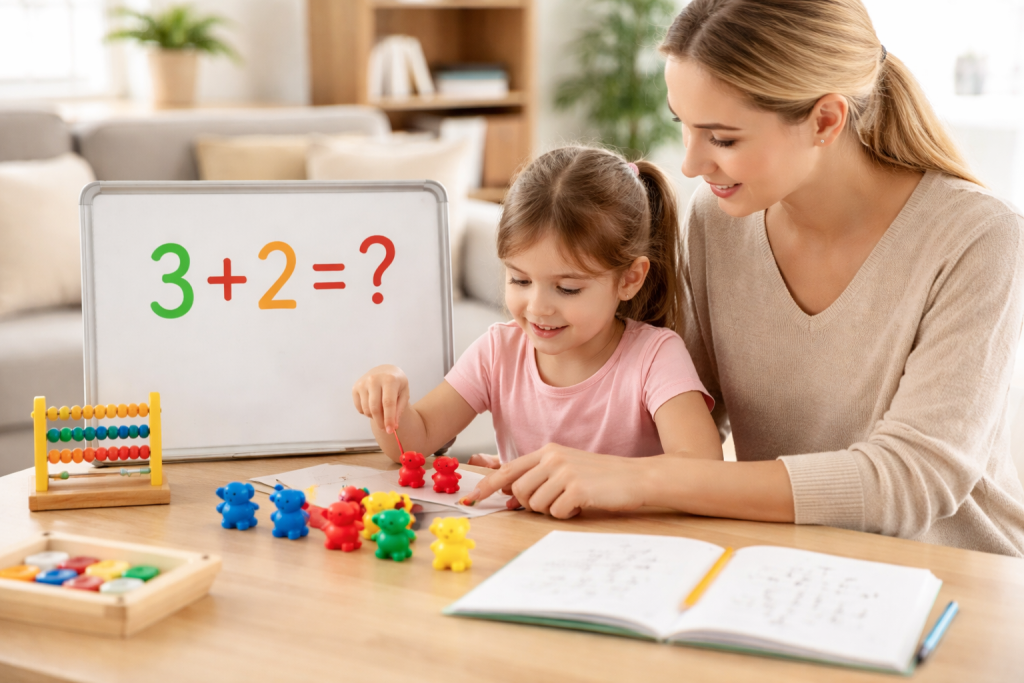
At its core, addition is about combining quantities. It’s the process of finding the total number of items when several groups are put together. Before introducing abstract symbols and equations, it’s crucial for young learners to grasp this fundamental concept through hands-on experiences. This builds an intuitive understanding that serves as a scaffold for later symbolic representation.
Contents
- 1 The Building Blocks: Counting and One-to-One Correspondence
- 2 From Counting to Combining: Conceptualizing “More”
- 3 The Power of Play: Making Addition Fun
- 4 Visualizing the Process: Using Manipulatives
- 5 Early Symbolism: Introducing Plus and Equals Signs
- 6 Building Fluency Through Patterns and Relationships
- 7 The Power of Practice: Games and Drills
- 8 Thinking Strategies: Doubles, Near Doubles, and Fact Families
- 9 Deconstructing Word Problems: Identifying the Question and Key Information
- 10 Visualizing Scenarios: Drawing Pictures to Solve
- 11 Real-World Application: Connecting Math to Daily Life
- 12 Catering to Diverse Learners: Scaffolding and Extension Activities
- 13 Tracking Growth: Monitoring Progress in Addition
- 14 Formative Assessment: Adjusting Instruction in Real-Time
- 15 The Digital Frontier: Online Platforms and Apps
- 16 Hands-On Learning: Manipulatives and Games
- 17 Visual Aids and Printables: Worksheets and Charts
The Building Blocks: Counting and One-to-One Correspondence
The journey to addition inherently starts with counting. Children must first develop a secure understanding of number sequence and the ability to count a set of objects accurately, ensuring each object is counted only once (one-to-one correspondence). Without a solid grasp of counting, the concept of “how many in total” becomes abstract and unmanageable. Educators can reinforce these skills through songs, games, and repeated exposure to counting various objects in their environment.
From Counting to Combining: Conceptualizing “More”
Once counting is established, the next step is to introduce the idea of “more”. This can be done by presenting two small groups of objects and asking the child to count each group separately, then to combine them and count the total. The language used is key here. Phrases like “How many do we have altogether?” or “If we put these together, how many will there be?” explicitly guide them towards the additive process.
Introducing addition to young learners requires patience, enthusiasm, and a gradual progression from concrete experiences to more abstract representations. The goal is to make this foundational concept engaging and accessible, ensuring every child feels confident and capable.
The Power of Play: Making Addition Fun
Play is a child’s natural language, and it’s an incredibly effective tool for introducing mathematical concepts. Games involving collecting, sharing, or building can be subtly adapted to practise addition. For instance, a game where children collect a certain number of teddy bears and then are given more can reinforce the concept of adding. Using dice in games also naturally introduces the idea of combining quantities.
Visualizing the Process: Using Manipulatives
Manipulatives are physical objects that children can touch, move, and arrange to represent mathematical ideas. In addition, these are invaluable. Counters, blocks, buttons, and even everyday items like pasta or dried beans can be used. Presenting two distinct groups of manipulatives and then physically merging them allows children to see the act of combining and then count the resulting total. This kinaesthetic learning solidifies the abstract concept.
Early Symbolism: Introducing Plus and Equals Signs
Once children have a concrete understanding of combining quantities, the introduction of symbolic notation can begin. Start with simple equations, perhaps using visual aids to represent the numbers. For example, showing two red blocks and three blue blocks, then writing “2 + 3 =” while physically combining the blocks, makes the transition to symbols more meaningful. The “equals” sign represents the result of the combination.
Developing fluency with addition facts, the basic sums from 0+0 to 10+10 (or higher, depending on curriculum), is crucial for efficient mathematical thinking. This doesn’t mean rote memorisation alone, but rather understanding number relationships and developing mental strategies.
Building Fluency Through Patterns and Relationships
Understanding how numbers relate to each other is a powerful strategy for learning addition facts. For example, once a child knows that 5 + 2 = 7, they can deduce that 2 + 5 = 7 (the commutative property). Similarly, knowing that 5 + 5 = 10 can help them understand that 5 + 6 is “one more than 10”, making it 11. Highlighting these number patterns and relationships makes memorisation less of a burden and more of an intellectual discovery.
The Power of Practice: Games and Drills
Consistent practice is essential for building automaticity with addition facts. However, practice doesn’t have to be tedious. Engaging games, flashcards with interactive elements, and online math platforms can make drills enjoyable. The key is to provide varied practice that reinforces understanding rather than just memorisation. Interval recall, where facts are revisited at increasing intervals, is particularly effective for long-term retention.
Thinking Strategies: Doubles, Near Doubles, and Fact Families
Specific thinking strategies can significantly aid in learning addition facts. “Doubles” (e.g., 3+3) are often easy to grasp. “Near doubles” build on this; if a child knows 4+4=8, they can figure out 4+5 by seeing it’s “one more” than 8, resulting in 9. “Fact families” connect addition and subtraction. For instance, if a child learns that 3 + 4 = 7, they also implicitly understand that 4 + 3 = 7, 7 – 3 = 4, and 7 – 4 = 3.
Addition is not just about calculating sums; it’s a fundamental tool for navigating and understanding the world around us. Teaching children to apply addition to solve real-world problems is a critical aspect of mathematical literacy.
Deconstructing Word Problems: Identifying the Question and Key Information
Word problems can be intimidating for young learners. Breaking them down into smaller, manageable steps is essential. This involves teaching children to identify what the problem is asking (the question) and what information is provided (the numbers and context) to help them find the answer. Underlining key numbers and circling the question are helpful visual strategies.
Visualizing Scenarios: Drawing Pictures to Solve
Encouraging children to draw a picture representing the situation described in a word problem can be an incredibly effective visual strategy. If a problem says, “Sarah has 3 apples, and her friend gives her 2 more,” drawing 3 apples and then adding 2 more next to them visually represents the addition needed to find the total. This bridges the gap between the narrative and the mathematical operation.
Real-World Application: Connecting Math to Daily Life
The most impactful way to teach problem-solving with addition is to make it relevant to children’s lives. From counting toys to figuring out how many cookies are left after sharing, everyday situations provide ample opportunities for addition practice. Discussing scenarios where addition is used, such as organising a party or planning a trip, helps children see the practical value of this mathematical skill.
Every child learns at their own pace and in their own way. Effective teaching of addition necessitates a differentiated approach, recognising and responding to individual needs, learning styles, and levels of understanding. Similarly, ongoing assessment is crucial to monitor progress and adjust instruction accordingly.
Catering to Diverse Learners: Scaffolding and Extension Activities
Differentiated instruction involves providing varying levels of support and challenge. For students who need more support, using more manipulatives, providing sentence starters for word problems, or focusing on smaller number ranges might be beneficial. For those ready for a challenge, introducing larger numbers, multi-step problems, or exploring subtraction as the inverse of addition can extend their learning.
Tracking Growth: Monitoring Progress in Addition
Regular, informal observation is a key part of assessing progress. Noting a child’s ability to count accurately, their confidence in using manipulatives, their strategies for solving addition facts, and their approach to word problems provides valuable insights. Formal assessments, such as short quizzes or fact fluency checks, can also be used, but they should be viewed as a snapshot of understanding rather than a definitive judgement.
Formative Assessment: Adjusting Instruction in Real-Time
Formative assessment is an ongoing process of gathering information about student learning to inform instruction. This could involve asking targeted questions during a lesson, observing student work on a task, or having brief one-on-one check-ins. The data gathered from formative assessments allows educators to make immediate adjustments to their teaching strategies, ensuring all students are receiving appropriate support and challenges.
A wealth of resources and tools are available to support the teaching and learning of addition. Leveraging these can make the process more engaging, efficient, and effective for both educators and students.
The Digital Frontier: Online Platforms and Apps
Numerous online platforms and educational apps are designed to make learning addition interactive and fun. These often incorporate gamified elements, adaptive learning pathways, and immediate feedback, helping students practise facts, explore concepts, and solve problems in a digital environment. Many resources offer progress tracking for both students and teachers.
Hands-On Learning: Manipulatives and Games
As previously mentioned, physical manipulatives are indispensable. Beyond basic counters, specialised math manipulatives like base-ten blocks, ten frames, and pattern blocks offer deeper insights into number composition and decomposition. Commercially available math games, as well as those that can be created easily with household items, provide engaging practice opportunities that reinforce addition concepts in a playful manner.
Visual Aids and Printables: Worksheets and Charts
Traditional but effective, printable worksheets and visual aids can supplement other learning methods. These can include activity sheets for practising specific addition facts, word problem worksheets, number charts, and visual representations of addition concepts. Many online repositories offer a wide array of free or affordable printable resources that cater to various learning objectives and age groups.
Emma Carter is an early childhood education enthusiast and content creator at Edyzoa. She is passionate about helping children learn through fun, engaging, and safe educational resources that support creativity, curiosity, and skill development.