
Engaging Young Minds: The Ultimate Guide to Teaching 4-Year-Olds
The world of a four-year-old is a vibrant kaleidoscope of curiosity, boundless energy, and burgeoning independence. At this crucial developmental stage, children are active learners, absorbing information at an astonishing rate and forging the foundational pathways for future learning. For educators and caregivers alike, understanding and effectively engaging these young minds is not merely a task but a joyous privilege. This guide explores the various facets of teaching four-year-olds, encompassing their unique developmental needs, fostering optimal learning environments, and strategies for holistically supporting their growth.

Contents
Understanding the Developmental Tapestry of 4-Year-Olds
Successfully engaging four-year-olds hinges on a deep appreciation of their distinct developmental trajectory. These are years marked by significant cognitive leaps, emotional blossoming, and a rapidly expanding social awareness. Recognizing these milestones allows us to tailor our approaches for maximum impact.
Cognitive Leaps and Curiosities
Four-year-olds are natural scientists, constantly questioning, exploring, and experimenting with their surroundings. Their curiosity is insatiable, driving them to understand how things work and why. They are developing the ability to think symbolically, engage in pretend play with elaborate scenarios, and categorize objects based on shared characteristics. While their attention spans are still developing, they can focus intently on activities that genuinely capture their interest. Understanding numbers, shapes, and colors is becoming more sophisticated, and they are beginning to grasp basic cause-and-effect relationships.
Emotional Flourishing and Self-Awareness
This age brings a significant growth in emotional intelligence. Four-year-olds are learning to identify and express a wider range of emotions, though they may still struggle with self-regulation. They are beginning to understand the feelings of others, fostering empathy, and navigating simple social dynamics. They are also developing a stronger sense of self, expressing preferences, and asserting their independence, which can sometimes manifest as challenging behaviors.
Expanding Social Horizons
The social world of a four-year-old is rapidly expanding beyond the immediate family unit. They are increasingly interested in interacting with peers, engaging in cooperative play, and understanding the concept of sharing and taking turns. While parallel play (playing alongside others without direct interaction) is still common, opportunities for collaborative play become more frequent and complex. These interactions are crucial for developing social skills, problem-solving, and understanding different perspectives.
Cultivating a Thriving Learning Ecosystem
Creating an environment that nurtures intellectual curiosity, emotional well-being, and social growth is paramount for four-year-olds. It’s not just about what we teach, but where and how they learn.
The Power of a Stimulating and Inviting Space
A well-designed learning environment for four-year-olds is a dynamic space that invites exploration and discovery. It should be rich in open-ended materials, organized in accessible ways, and provide various zones for different activities. Think cozy corners for quiet reading, open areas for gross motor play, and dedicated stations for art, sensory exploration, and constructive building. The aesthetic should be child-friendly, with colorful yet not overwhelming decorations and natural light whenever possible. The physical layout should also allow for easy supervision while promoting independence.
Embracing Play as the Ultimate Teacher
For four-year-olds, play is not just fun; it is their primary mode of learning. Incorporating play-based learning means designing activities where children learn through direct experience, exploration, and self-directed engagement. This could involve dramatic play scenarios that foster language and social skills, block play that develops spatial reasoning, or sensory bins that enhance fine motor skills and scientific inquiry. Structured play, where educators introduce a concept and then allow children to explore it through play, is particularly effective.
Intentional Design for Exploration and Discovery
Every element in the learning environment should be intentionally placed to encourage specific developmental skills. Low shelves filled with books promote literacy. A sand and water table sparks scientific investigation. Dress-up clothes and props fuel imaginative role-playing. The arrangement should also be flexible, allowing for easy adaptation to children’s evolving interests and learning needs.
Fostering Holistic Development: Beyond Academics
While intellectual growth is important, a truly comprehensive approach to teaching four-year-olds acknowledges the interconnectedness of all developmental domains.
Nurturing Emotional Intelligence and Social Competence
Building a foundation of strong social and emotional skills is critical for future success. This involves explicitly teaching emotional vocabulary, providing opportunities for children to express their feelings in healthy ways, and modeling empathetic behavior. Conflict resolution strategies, such as using “I” statements and active listening, should be gently introduced. Group activities that promote cooperation, sharing, and compromise are essential. Circle time, where children can share their thoughts and feelings, also plays a significant role in building community and fostering self-expression.
Unlocking the Power of Language and Literacy
The preschool years are a golden age for language acquisition and the blossoming of early literacy skills. Engaging four-year-olds in rich conversations, reading aloud frequently, and singing songs are fundamental. Introducing print-rich environments with labels, signs, and children’s writing tools encourages an understanding of the written word. Phonological awareness activities, such as rhyming games and identifying initial sounds, lay the groundwork for reading. Encouraging storytelling, both verbal and through drawing, nurtures narrative skills and imagination.
Igniting Creativity and Fueling Imagination
Creativity and imagination are the cornerstones of innovative thinking and problem-solving. Providing open-ended art materials like paints, clay, and various collage elements allows children to express themselves without rigid expectations. Encouraging dramatic play with a variety of costumes and props further stimulates imagination. Story prompts and “what if” questions can inspire children to think divergently and explore new possibilities. The emphasis should always be on the process of creation, not solely on the final product.
Hands-On Adventures in Science and Math
Four-year-olds are natural scientists and mathematicians. Introducing basic scientific concepts through hands-on experiments, such as exploring properties of water, planting seeds, or observing insects, makes learning tangible and exciting. Similarly, early math concepts like counting, sorting, patterning, and comparing quantities can be explored through play with manipulatives, building blocks, and everyday objects. The focus should be on discovery and understanding, rather than rote memorization.
Building Strong Bodies: Physical Development and Motor Skills
Gross motor skills, such as running, jumping, climbing, and throwing, are crucial for physical development and overall well-being. Providing ample opportunities for outdoor play and active indoor games is essential. Fine motor skills, vital for writing and self-care, are developed through activities like drawing, cutting with scissors, manipulating small objects, and using playdough. Integrating movement into learning, such as singing action songs or doing “brain breaks,” further enhances engagement and physical development.
Teaching four-year-olds is a collaborative endeavor that extends beyond the classroom walls. Building strong partnerships with families and developing effective behavior management strategies are key to successful outcomes.
The Cornerstone of Positive Relationships with Families
Families are a child’s first and most enduring educators. Building positive, respectful relationships with parents and guardians is crucial for creating a cohesive support system. Regular communication, sharing insights into a child’s progress, and inviting family participation in school activities strengthens this partnership. Understanding family values and cultural backgrounds allows educators to tailor their approach and create a truly inclusive environment.
Gentle Guidance: Addressing Challenges and Behavior Management
All four-year-olds will exhibit challenging behaviors as they learn to navigate their emotions and social world. Effective behavior management for this age group focuses on positive reinforcement, clear and consistent expectations, and teaching self-regulation skills. Rather than punishment, redirection, logical consequences, and offering choices are more effective strategies. Understanding the root cause of a behavior, whether it’s hunger, tiredness, overstimulation, or a lack of a particular skill, is vital for addressing it proactively and empathetically. Creating a predictable routine provides a sense of security, which can significantly reduce behavioral issues. Teaching children how to express their feelings verbally instead of through actions, and providing calming strategies like deep breaths, further empowers them to manage their own behaviors.
In essence, guiding four-year-olds is a dynamic and deeply rewarding journey. By understanding their unique developmental needs, fostering a stimulating and playful learning environment, and embracing a holistic approach to their growth, we equip these young minds not just with knowledge but also with the curiosity, resilience, and joy for lifelong learning that will shape their future.
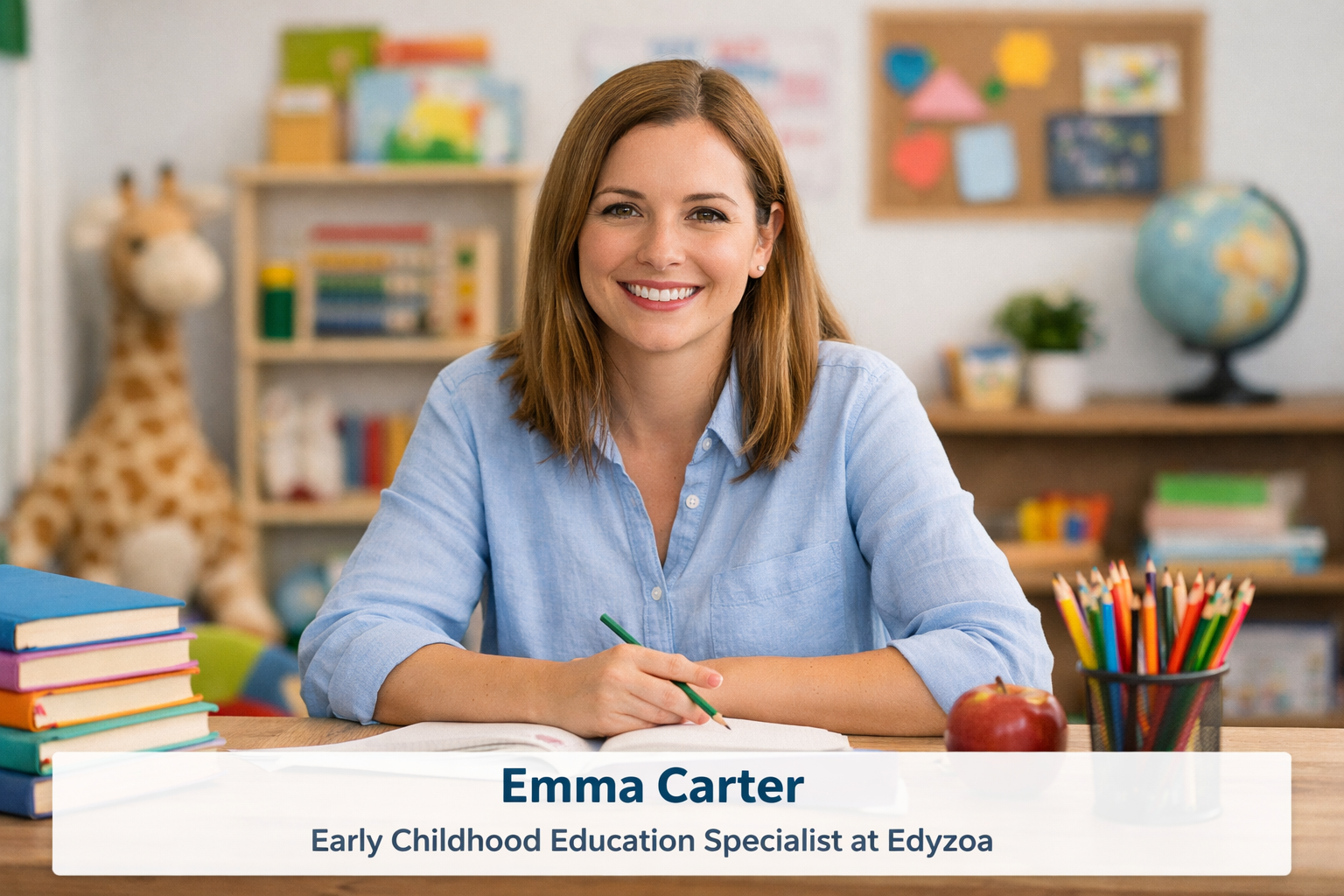
Emma Carter is an early childhood education enthusiast and content creator at Edyzoa. She is passionate about helping children learn through fun, engaging, and safe educational resources that support creativity, curiosity, and skill development.