
From Chaos to Consistency: Building a Structured Learning Routine for Home Education
The journey of home education, while offering unparalleled freedom and personalisation, can sometimes feel like navigating a vast ocean without a compass. The sheer breadth of subjects, the flexibility in pacing, and the unique needs of each child can easily lead to a sense of disarray, a state of “chaos” where learning feels haphazard and progress uncertain. Yet, within this apparent freedom lies a profound opportunity for a different kind of order: structure. Building a structured learning routine is not about rigid confinement; rather, it is about establishing a supportive framework that fosters deep understanding, consistent growth, and a love for lifelong learning.
The appeal of home education frequently arises from the capacity to diverge from traditional classroom limitations. This flexibility is a powerful asset, allowing educators to cater to individual strengths, weaknesses, and interests. However, without a guiding structure, this same flexibility can become a breeding ground for inconsistency. Imagine a day where learning is dictated solely by whims or immediate interests. While occasional deviations are beneficial, a consistent lack of routine can result in gaps in knowledge, missed learning opportunities, and a general feeling of being overwhelmed for both the child and the parent.
Contents
- 1 Cultivating Discipline and Self-Management
- 2 Ensuring Comprehensive Curriculum Coverage
- 3 Maximizing Learning Efficiency
- 4 The Daily Flow: Establishing a Rhythmic Cadence
- 5 Weekly Frameworks: Building Blocks for Progress
- 6 Visualizing the Routine: Tools for Clarity
- 7 The Dedicated Learning Zone: A Space for Focus
- 8 Minimizing Physical Distractions: Tidying Up for Focus
- 9 Managing Sensory Input: Creating a Calming Atmosphere
- 10 Responsive Teaching: Adapting to the Moment
- 11 Integrating Incidental Learning: Seizing Teachable Moments
- 12 Rhythmic Variation: Avoiding Monotony
- 13 Defining Academic Milestones: What Needs to Be Learned?
- 14 Nurturing Life Skills and Character Development: Beyond Academics
- 15 Communicating Goals: Ownership and Motivation
- 16 Visual Learners: Seeing the Path to Understanding
- 17 Auditory Learners: Hearing Their Way to Knowledge
- 18 Kinesthetic Learners: Learning by Doing and Moving
- 19 Reading/Writing Learners: The Power of the Pen and Page
- 20 Proactive Distraction Management: Anticipating and Mitigating
- 21 Developing Focus Techniques: Building Mental Stamina
- 22 The Power of Engagement: Making Learning Captivating
- 23 Intentional Design and Implementation: The Master Planner
- 24 Modeling and Mentorship: Leading by Example
- 25 Consistent Reinforcement and Positive Encouragement
- 26 Developmental Shifts: Catering to Maturing Minds
- 27 Evolving Interests and Passions: Embracing New Horizons
- 28 Regular Review and Refinement: A Constant Dialogue
- 29 Fostering Academic Excellence: Solidifying Knowledge
- 30 Cultivating Independence and Self-Reliance: Empowering Learners
- 31 Reducing Stress and Anxiety: Creating a Calm Learning Space
- 32 Building Stronger Family Bonds: Shared Learning Experiences
Cultivating Discipline and Self-Management
A structured routine instills a sense of discipline from an early age. Children learn to anticipate learning blocks, understand expectations, and develop self-management skills that extend far beyond academic pursuits. This structured environment provides predictable anchors in their day, reducing anxiety and giving them a sense of safety. Knowing what to expect and when allows them to mentally prepare for different learning activities, leading to greater engagement and a more proactive approach to their education.
Ensuring Comprehensive Curriculum Coverage
A structured learning routine systematically covers the entire curriculum, which is one of its primary benefits. Without a plan, it’s easy to neglect certain subjects and give others disproportionate attention. Regularly addressing core subjects and providing opportunities for exploration in arts, sciences, practical life skills, and other areas of interest are the hallmarks of a well-designed schedule. This balanced approach nurtures well-rounded individuals, equipping them with a broad knowledge base.
Maximizing Learning Efficiency
When learning is approached with a consistent structure, efficiency naturally increases. Children become accustomed to transitioning between subjects and tasks, minimising the time lost in indecision or disorganisation. Furthermore, understanding dedicated learning times helps them enter a focused state more readily. This predictable rhythm allows for deeper immersion in each subject, leading to more meaningful retention and comprehension rather than a superficial skim of various topics.
The act of creating a consistent schedule is the cornerstone of transforming potential chaos into a harmonious learning environment. This isn’t about dictating every minute of the day but rather about establishing predictable blocks of time dedicated to learning, exploration, and rest. The process begins with understanding the rhythms and needs of the child, considering their optimal focus times, energy levels, and any existing commitments.
The Daily Flow: Establishing a Rhythmic Cadence
A typical home education day might incorporate blocks for core academics, followed by creative pursuits, physical activity, and free play. The order doesn’t need to be rigid, but the presence of these designated periods provides a reassuring structure. For younger children, shorter, more frequent learning bursts may be more effective, while older children can often sustain longer periods of focused study. The key is to find a flow that resonates with the child’s developmental stage and individual learning patterns.
Weekly Frameworks: Building Blocks for Progress
Beyond the daily rhythm, a weekly framework provides a broader perspective. This might involve dedicating specific days to certain subjects or themes or interleaving them throughout the week. For instance, Mondays could focus on maths and science, Tuesdays on language arts and history, and so on. This allows for a deeper dive into each area without the pressure of covering everything every single day. It also provides opportunities for recurring activities that build momentum and familiarity.
Visualizing the Routine: Tools for Clarity
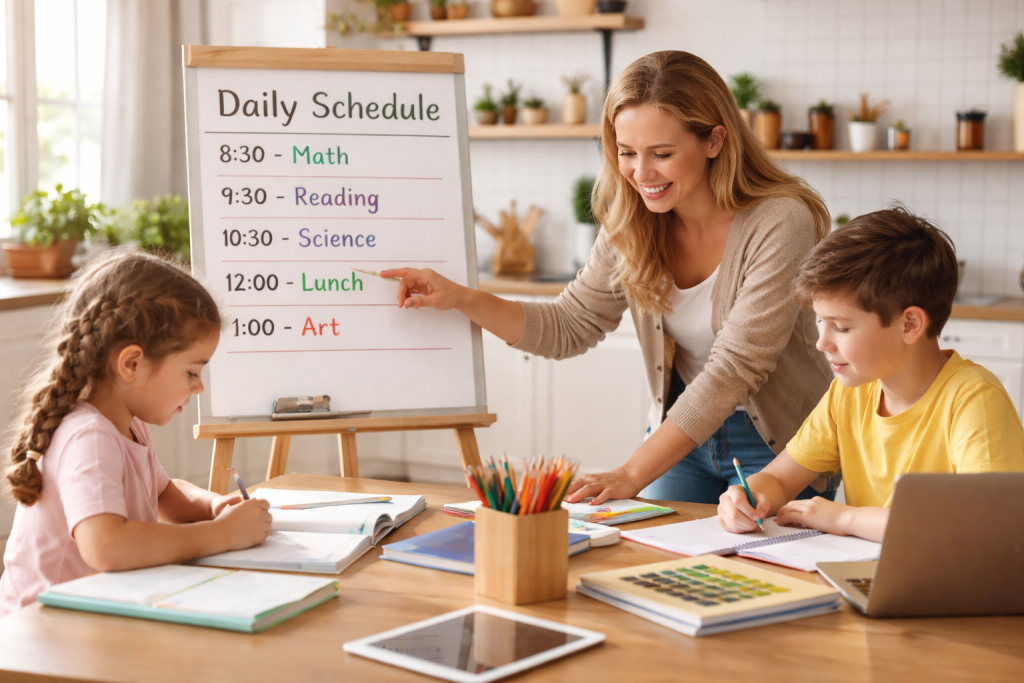
Visibility and accessibility enhance the effectiveness of a schedule. This could take the form of a whiteboard calendar, a printed daily planner, or a digital app. For younger children, visual aids like picture schedules can be incredibly beneficial, offering a clear and engaging representation of their day. For older children, a more detailed written schedule can empower them to take ownership of their learning and time management.
The physical space in which learning takes place significantly influences focus and engagement. Establishing a structured learning environment goes beyond just setting a schedule; it involves creating a dedicated area that signals “learning time” and minimises potential disruptions. This dedicated space doesn’t need to be a separate room; it can be a designated corner of a living room, a well-organised desk, or even a particular spot at the kitchen table.
The Dedicated Learning Zone: A Space for Focus
Creating a dedicated learning zone, however modest, signals a transition into academic mode. This area should be free from the clutter of toys and entertainment devices. It should be comfortable, well-lit, and equipped with the necessary supplies – books, paper, pens, art materials, and any technology required for learning. The mere act of entering this space can help children shift their mindset toward learning.
Minimizing Physical Distractions: Tidying Up for Focus
Physical clutter can be a significant distraction. Regular tidying and organisation of the learning space are crucial. Ensure that materials are readily accessible but neatly stored. This minimises the time spent searching for items, allowing for more uninterrupted learning. The principle of “a place for everything and everything in its place” is invaluable in a home education setting.
Managing Sensory Input: Creating a Calming Atmosphere
Consider the sensory experience of the learning environment. Excessive noise, particularly from siblings or household activities, can be disruptive. Techniques to manage this could include establishing quiet hours during learning times, using noise-cancelling headphones for focused tasks, or even playing soft instrumental music that promotes concentration. The aim is to create a calm and conducive atmosphere that supports deep thinking.
The beauty of home education lies in its adaptability. While structure is essential, it should not stifle creativity or the ability to respond to spontaneous learning opportunities. The goal is to find a harmonious balance between a predictable framework and the freedom to explore emergent interests. Here is where home education truly excels.
Responsive Teaching: Adapting to the Moment
A rigid schedule that cannot accommodate a child’s sudden fascination with a particular scientific phenomenon or a historical event is counterproductive. Effective home education involves being responsive to these moments. If a child is deeply engaged in a spontaneous exploration, it might be more beneficial to allow them to pursue it for a while, perhaps integrating it into their learning later, rather than forcing them back to a predetermined lesson.
Integrating Incidental Learning: Seizing Teachable Moments
Many of the most valuable learning experiences at home arise organically. Prime examples of incidental learning include converting a trip to the grocery store into a math lesson on budgeting or a nature walk into a biology study. We can incorporate these teachable moments without disrupting the entire day with a flexible structure. The routine can act as a gentle guide, with space for these enriching detours.
Rhythmic Variation: Avoiding Monotony
While consistency is key, introducing variation within the routine can prevent monotony and maintain engagement. This could involve changing the location of learning sessions, introducing new learning materials, or incorporating different teaching methods. For example, a history lesson might be presented through reading, followed by a documentary, and then a creative writing exercise, all within the same thematic block.
A structured learning routine is most effective when it is guided by clear goals and objectives. Without a destination in mind, even the most organised journey can feel aimless. Defining what you want your child to learn and achieve provides direction, purpose, and a benchmark for progress.
Defining Academic Milestones: What Needs to Be Learned?
Start by identifying the essential academic knowledge and skills your child needs to acquire. This might be guided by state standards, curriculum guides, or your own assessment of their developmental needs. Break down large subjects into smaller, manageable learning objectives. For example, instead of aiming to “learn algebra”, set a goal to “understand basic algebraic equations” within a specific timeframe.
Nurturing Life Skills and Character Development: Beyond Academics
Home education offers a unique opportunity to focus on the holistic development of a child. Beyond academic goals, consider objectives related to practical life skills, social-emotional learning, character development, and fostering a love for exploration. These might include objectives like “developing independent cooking skills”, “practicing empathy and conflict resolution”, or “cultivating a habit of reading for pleasure”.
Communicating Goals: Ownership and Motivation
Crucially, communicate these goals and objectives with your child in an age-appropriate manner. Understanding the purpose of their learning increases children’s motivation and engagement. Involving them in the goal-setting process, especially with older children, gives them control over their education and encourages self-direction.
Every child is a unique learner, possessing a distinct blend of learning styles. A truly structured learning routine acknowledges and caters to these diverse preferences, ensuring that learning is accessible and engaging for everyone. This involves understanding the different ways children absorb, process, and retain information.
Visual Learners: Seeing the Path to Understanding
Visual learners thrive with aids that appeal to their sight. Incorporating visual elements into your routine is paramount. This includes using diagrams, charts, mind maps, flashcards, illustrations in books, educational videos, and even visually appealing worksheets. When planning lessons, think about how you can present information graphically.
Auditory Learners: Hearing Their Way to Knowledge
Auditory learners benefit from spoken words and sounds. This style can be integrated through read-aloud sessions, discussions, debates, audiobooks, educational podcasts, and encouraging children to explain concepts aloud to you or a sibling. Music and rhythm can also be powerful tools for memory and engagement for auditory learners.
Kinesthetic Learners: Learning by Doing and Moving
Kinaesthetic learners learn best through physical activity and hands-on experiences. Their learning routine should be rich with opportunities for movement and manipulation. This can involve building models, conducting experiments, role-playing historical events, engaging in hands-on math manipulatives, or incorporating physical games that reinforce academic concepts.
Reading/Writing Learners: The Power of the Pen and Page
For learners who excel through the written word, incorporate ample opportunities for reading and writing. This means engaging with books, writing essays, keeping journals, creating stories, summarising information, and taking notes. Ensure a steady supply of varied reading materials and provide ample opportunities for them to express their understanding through writing.
Despite the best-laid plans, distractions are an inherent part of any home environment. The key to successful home education is developing strategies to manage these disruptions and cultivate sustained focus, transforming potential interruptions into manageable moments.
Proactive Distraction Management: Anticipating and Mitigating
Anticipate common distractions and implement proactive strategies. This might involve establishing clear rules about screen time during learning hours, communicating with other family members about designated quiet times, and ensuring that the learning space is a sanctuary from non-educational stimuli. Having a designated area for toys and games, separate from the learning zone, can also be very effective.
Developing Focus Techniques: Building Mental Stamina
Teach your child self-regulation techniques to help them manage distractions when they arise. This could include simple mindfulness exercises, deep breathing techniques, or using a timer to break down tasks into manageable “focus sprints”. Encouraging short, regular breaks can also prevent mental fatigue, which often leads to increased susceptibility to distractions.
The Power of Engagement: Making Learning Captivating
Perhaps the most powerful tool against distractions is making learning inherently engaging and relevant. When children are genuinely interested in a topic, they are far more likely to stay focused. Connect learning to their real-world experiences, allow for choices in how they learn, and foster a sense of curiosity and discovery.
Parents are the architects, facilitators, and primary educators in the home education journey. Their role in building and maintaining a structured learning routine is paramount, requiring a blend of intentionality, patience, and adaptability.
Intentional Design and Implementation: The Master Planner
Parents are responsible for the initial design and ongoing implementation of the learning routine. This involves researching curricula, understanding developmental stages, and creating a schedule that aligns with the family’s values and goals. It also means consistently guiding the child through the routine, providing encouragement, and reinforcing expectations.
Modeling and Mentorship: Leading by Example
Children learn by observing. Parents who demonstrate enthusiasm for learning, a commitment to organisation, and a positive attitude towards challenges will inspire similar qualities in their children. Modelling good study habits, demonstrating a love for reading, and showing patience when facing obstacles all contribute to a supportive learning environment.
Consistent Reinforcement and Positive Encouragement
A structured routine thrives on consistent reinforcement. This doesn’t mean punishment but rather positive affirmations, praise for effort and progress, and gentle redirection when a child strays from the established pattern. Acknowledging and celebrating achievements, big or small, builds motivation and reinforces the value of the routine.
A structured learning routine is not a static document; it is a living, breathing framework that must evolve alongside the child. As children mature, their needs, interests, and learning capacities change, necessitating adjustments to the established schedule and environment.
Developmental Shifts: Catering to Maturing Minds
As children move from early childhood through adolescence, their cognitive abilities, attention spans, and independence levels will vary significantly. A routine that works for a five-year-old will likely need substantial modification for a ten-year-old or a teenager. Adjustments should consider increased complexity of subjects, longer periods of independent study, and the development of more sophisticated organisational skills.
Evolving Interests and Passions: Embracing New Horizons
Children’s interests are dynamic. As they discover new passions, the learning routine should offer opportunities to explore these areas in depth. This might involve allocating more time to specific subjects, incorporating new resources, or even shifting the focus of some learning blocks to accommodate emerging enthusiasms. Flexibility is key to nurturing a child’s burgeoning intellectual curiosity.
Regular Review and Refinement: A Constant Dialogue
Regularly review the effectiveness of the routine with your child. What is working well? What are the challenges? What changes would they suggest? This ongoing dialogue fosters collaboration and ensures that the routine remains relevant and supportive of their learning journey. Open communication allows for timely adjustments and prevents the routine from becoming outdated or burdensome.
The cumulative effect of a well-established, structured learning routine is profound and far-reaching. Consistency, the bedrock of this structure, cultivates a multitude of benefits that extend far beyond academic achievement.
Fostering Academic Excellence: Solidifying Knowledge
Consistent exposure to learning materials and concepts leads to deeper understanding and better retention. The predictable rhythm of a structured routine allows for regular revisiting of topics, reinforcing learning and building a solid foundation of knowledge. This systematic approach minimises gaps and ensures a comprehensive grasp of subjects.
Cultivating Independence and Self-Reliance: Empowering Learners
When children understand and navigate their learning routines, they develop a strong sense of independence and self-reliance. They learn to manage their time, prioritise tasks, and take ownership of their learning. This cultivates a proactive attitude that serves them well throughout their lives, empowering them to become lifelong learners.
Reducing Stress and Anxiety: Creating a Calm Learning Space
A predictable and structured environment significantly reduces stress and anxiety for both children and parents. Knowing what to expect, having clear expectations, and feeling organised can transform learning from a source of pressure into an enjoyable and manageable experience. This calm atmosphere is conducive to effective learning and emotional well-being.
Home education, when structured effectively, can provide numerous opportunities for shared learning experiences that strengthen family bonds. Working collaboratively on projects, engaging in discussions, and celebrating learning milestones together fosters connection and a sense of shared purpose. The routine, rather than isolating individuals, can become a vehicle for enhanced family interaction.
In conclusion, the transition from the potential chaos of an unstructured approach to the harmonious efficiency of a consistent learning routine is a journey worth embracing. By understanding the importance of structure, skilfully creating a balanced schedule, establishing a conducive environment, setting clear goals, catering to diverse learning styles, managing distractions, and adapting as needed, parents can build a robust framework for home education that not only fosters academic success but also nurtures well-rounded, independent, and confident individuals ready to navigate the complexities of the world, equipped with the enduring power of a structured learning habit.

Emma Carter is an early childhood education enthusiast and content creator at Edyzoa. She is passionate about helping children learn through fun, engaging, and safe educational resources that support creativity, curiosity, and skill development.