
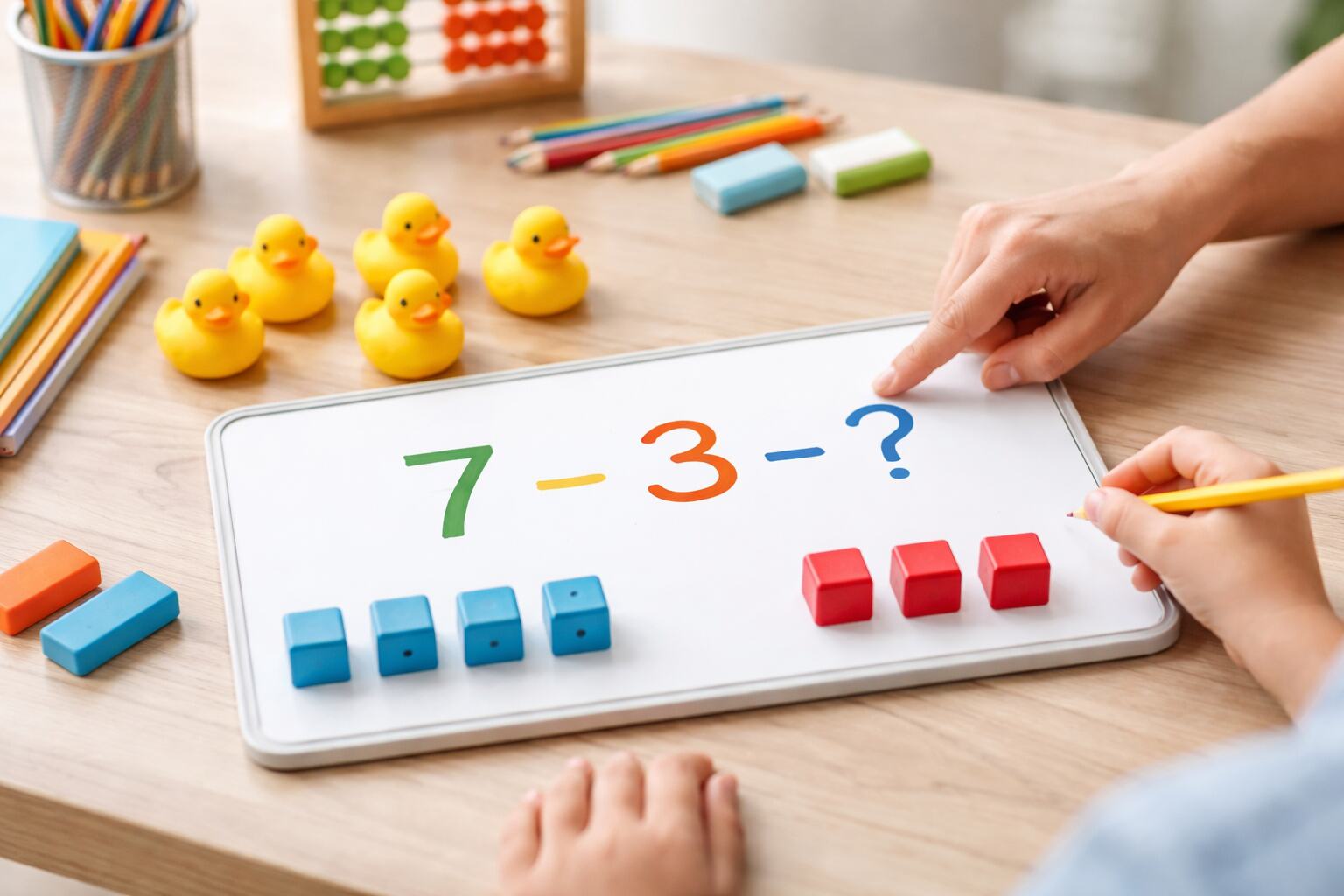
Subtraction, a fundamental operation in mathematics, forms the bedrock of countless numerical calculations we perform daily. From balancing a chequebook to understanding discounts at a Supermarket, a firm grasp of subtraction is indispensable. This guide aims to demystify the concept of subtraction for beginners, offering a comprehensive and easy-to-follow approach to mastering this essential skill.
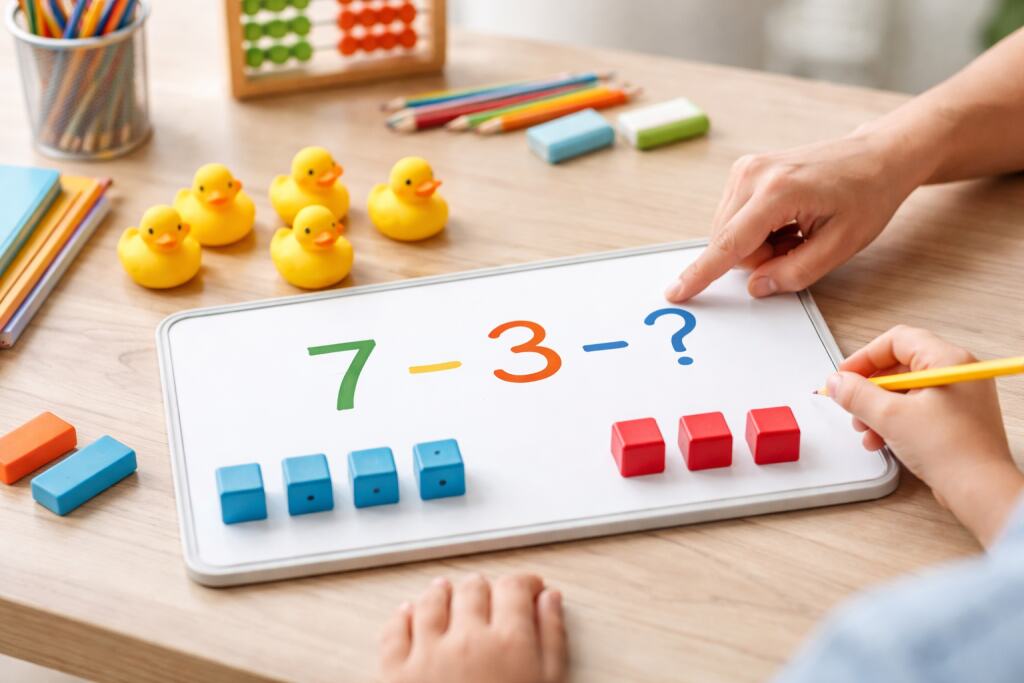
At its core, subtraction is the process of taking one number away from another. It’s about finding the difference between two quantities. Imagine you have a certain number of objects, and you remove some of them; the remaining objects represent the result of a subtraction problem.
What Subtraction Represents
Subtraction can be thought of as several distinct actions. It’s about “taking away” – like having 5 apples and giving 2 away, leaving 3. It’s also about finding the “difference” – how much larger one number is than another. If John has 7 toys and Mary has 4, the difference in their toys is 3. Furthermore, subtraction can represent “how many more are needed” to reach a certain number. If you need 10 cookies for a party and you only have 6, you need 4 more. Understanding these various interpretations helps solidify the conceptual foundation.
Related Mathematical Concepts
Subtraction is intrinsically linked to addition. They are inverse operations. If you add 3 to 5 to get 8, then subtracting 3 from 8 will bring you back to 5. This inverse relationship is crucial for checking answers and for understanding more advanced mathematical concepts later on. It also lays the groundwork for understanding negative numbers when you subtract a larger number from a smaller one.
The importance of basic subtraction skills cannot be overstated. Without a solid understanding of this fundamental operation, progressing to more complex mathematical topics becomes a significant challenge. It underpins concepts like division, algebra, and even financial literacy. Think about budgeting; you subtract expenses from your income. Consider sports scores; the difference in points determines the winner.
To effectively perform subtraction, it’s vital to be familiar with the symbols and terms used. Mathematics, like any language, has its own vocabulary.
The Subtraction Symbol and Its Meaning
three”.The primary symbol for subtraction is the minus sign (–). It signifies that the number immediately following it is to be taken away from the number preceding it. For example, 7 – 3 means “seven minus three” or “seven take away three.”
Key Terms in Subtraction
Several specific terms are used in subtraction problems. The minuend is the number from which another number is subtracted. The subtrahend is the number being subtracted. The result of a subtraction problem is called the difference. In the problem 7 – 3 = 4, 7 is the minuend, 3 is the subtrahend, and 4 is the difference. Clear understanding of these terms will help in following instructions and solving problems.
Let’s break down the process of performing basic subtraction, starting with single-digit numbers and progressing to larger ones.
Single-Digit Subtraction
Memorised: single-digit subtraction is the simplest form. For example, to solve 5 – 2, you can imagine 5 fingers and then put down 2 of them, leaving 3. As you practice, these facts become memorized. Counting backwards is another effective strategy: start at 5 and count back two numbers (4, 3), arriving at 3.
Double-Double and Triple-Digit Subtraction Without Borrowing
When subtracting larger numbers, we perform the operation column by column, starting from the rightmost digit (the ones place). If we have 48 – 23, we first subtract the ones: 8 – 3 = 5. Then we subtract the tens: 4 – 2 = 2. The result is 25. This is straightforward when each digit in the minuend is greater than or equal to the corresponding digit in the subtrahend.
Double-Double and Triple-Digit Subtraction With Borrowing (Regrouping)
This is where subtraction can become a bit trickier for beginners, but with practice, it becomes intuitive. “Borrowing” or “regrouping” is necessary when a digit in the subtrahend is larger than the corresponding digit in the minuend.
Consider 52 – 27.
- Start with the ones column: We need to subtract 7 from 2. Since 2 is smaller than 7, we cannot directly subtract.
- We “borrow” from the tens place. The 5 in the tens place (representing 50) becomes 4 (representing 40), and the 10 we borrowed is added to the 2 in the ones place, making it 12.
- Now, subtract the ones: 12 – 7 = 5.
- Move to the tens column: We now have 4 (from the original 5 after borrowing) minus 2, which equals 2.
- The final difference is 25.
Practice with numerous examples is key to mastering this concept.
Memorising basic subtraction facts is essential for speed and accuracy in more complex calculations.
Flashcards and Practice Drills
memorisation.Flashcards are an excellent tool for memorization. Create cards with a subtraction problem on one side (e.g., 9–4) and an answer on the other (5). Regular, short practice sessions are more effective than infrequent, long ones. Online practice drills and apps can also provide endless opportunities for repetition and instant feedback.
Relating Subtraction to Addition
yourself,As mentioned, subtraction and addition are inverse operations. If you know that 3 + 5 = 8, then you automatically know that 8 – 5 = 3 and 8 – 3 = 5. Using this relationship, you can significantly reduce the number of facts you need to memorise independently. When faced with a subtraction problem like 12–7, ask yourself, “What number added to 7 gives me 12?”
Using Number Lines and Counting Backwards
backwardsFor visual learners, a number line can be incredibly helpful. To solve 7–3, start at 7 on the number line and jump backward 3 spaces. You will land at 4. Similarly, counting backward is an effective mental strategy. To solve 9 – 2, start at 9 and count back two numbers: 8, 7.
For many beginners, especially younger learners, abstract numbers can be challenging. Concrete objects and visual representations make subtraction tangible and understandable.
Counting Objects (Counters, Blocks)
Visualise: Using physical objects like blocks, counters, or even jelly beans helps children visualize the “taking away” process. If you have 8 blocks and you want to subtract 3, physically remove 3 blocks and count the remaining ones. This hands-on experience solidifies the concept before transitioning to purely numerical problems.
Ten Frames and Part-Whole Models
Ten frames are grids of two rows of five cells, used to teach counting, addition, and subtraction. To subtract 7 – 4 using a ten frame, place 7 counters on the frame, then remove 4 of them. The remaining counters represent the difference. Part-whole models, represented by circles or boxes, show how a whole number can be broken down into two or more parts. For subtraction, the whole is the minuend, one part is the subtrahend, and the other part is the difference.
Pictorial Representations (Drawings)
away;Encourage drawing pictures. If a problem states, “There are 6 birds on a tree, and 2 fly away, how many are left?” drawing 6 birds and then crossing out 2 of them provides a clear visual solution. This tip is especially useful for word problems.
Identifying and understanding common pitfalls can help beginners sidestep these errors and strengthen their understanding.
Forgetting to Regroup (Borrow)
Emphasising: This is perhaps the most frequent error. Learners attempting to subtract a larger digit from a smaller one in a column without borrowing will often write the difference as the larger digit minus the smaller (e.g., 3 – 7 = 4, instead of realising that borrowing is needed). Emphasizing the “cannot subtract” rule and the need to regroup is crucial.
Incorrectly Regrouping Across Zeros
Regrouping when there’s a zero in the tens or hundreds place can be confusing. For instance, in 402 – 135, when borrowing for the ones place, you need to borrow from the tens, but the tens place is zero. You then need to borrow from the hundreds place, turning the 4 into a 3, making the tens place 10, then borrowing from that 10 to make it 9 and giving 10 to the ones place, making it 12. This multi-step regrouping requires careful attention.
Not Aligning Numbers Correctly
When dealing with multi-digit subtraction, especially without grid paper, misaligning the digits by place value (ones under tens, etc.) can lead to incorrect answers. Always stress the importance of lining up the rightmost digits meticulously.
The true value of learning mathematics lies in its practical applications. Subtraction is interwoven into our daily lives.
Managing Money and Budgeting
When you go shopping and have a certain amount of money, and you buy something, you subtract the cost from your total to see how much you have left. Budgeting involves subtracting expenses from income to ensure you don’t overspend. Calculating discounts (original price minus discount amount) is another common use.
Time Management and Scheduling
If a meeting starts at 10:00 AM and lasts for 45 minutes, you subtract 45 minutes from 10:00 AM to determine the end time. Calculating how much time is left until an event or how long an activity took involves subtraction.
Measuring and Comparing Quantities
Comparing heights, weights, or distances often involves subtraction to find the difference. If one tree is 15 feet tall and another is 8 feet tall, subtracting 8 from 15 tells you the difference in their heights. Cooking sometimes requires adjusting recipes by subtracting ingredients.
Mastering basic subtraction is not an end in itself but a vital stepping stone to more advanced mathematical concepts.
Introduction to Negative Numbers
When you subtract a larger number from a smaller number (e.g., 3–7), you delve into the realm of negative numbers. For instance, if you have $3 and you spend $7, you are in debt $4. This concept builds directly on the foundational understanding of subtraction as “taking away.”
Subtraction with Fractions and Decimals
Once fractions and decimals are introduced, the principles of subtraction remain the same, but with added complexities. For fractions, you need common denominators. For decimals, you need to align the decimal points. The core idea of finding the difference, however, is constant.
Solving Algebraic Equations
Many simple algebraic equations require subtraction to isolate a variable. For example, to solve x + 5 = 12, you subtract 5 from both sides of the equation to find x = 7. A strong command of subtraction makes these initial forays into algebra much smoother.
Continuous practice is key to long-term retention and proficiency. Fortunately, a wealth of resources is available.
Educational Websites and Apps
Numerous websites like Khan Academy, Math Playground, and ABCya offer interactive games, video lessons, and practice problems specifically designed to reinforce subtraction skills for various age groups and learning styles. Educational apps on tablets and smartphones also provide engaging and portable practice opportunities.
Workbooks and Practice Sheets
Traditional workbooks and printable practice sheets remain highly effective. They allow for focused, deliberate practice, and they are excellent for developing neatness and organization in numerical work. Look for books that gradually increase in difficulty and include varied problem types.
Everyday Opportunities for Practice
Integrate subtraction into daily routines. Ask children to calculate change at the store, determine how many more points their favourite team needs to win, or figure out the difference in age between family members. These real-world applications make learning relevant and enjoyable. Consistent effort in these areas will transform a beginner into a proficient subtractor, ready to tackle more intricate mathematical challenges.